.

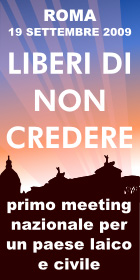
September 19, 2009, ROME
FREE TO NOT BELIEVE
first national meeting for a secular country and civil
were a few million, one hundred years ago. Today there are about a billion. The tremendous increase in the number of non-believers is the only significant novelty in religious world in recent decades. A phenomenon which, however, does not mention at all in democratic countries to stop: a growth which, significantly, is not the result of the work of 'missionaries' of atheism and agnosticism, but the outcome of hundreds of millions of thoughts individual. Fact even more eloquent, their spread is greater, the greater the spread of wealth, education, freedom of expression. Far from bringing the company to ruin, as religious leaders, prophesied unable to find appropriate responses to secularization, atheists and agnostics are its most dynamic, one that most contributes to their growth: the average of the population are younger, more educated, more open to new, more tolerant of those who are too often portrayed as 'different': foreigners, homosexuals, single mothers, belonging to minority religions.
Almost everywhere the political world has seen these changes, making its mark on the national legislation on standards, less dependent on the prevailing religious ethics (as yet?), And enhancing self-determination for the control of individuals. Even in a "Christian nation" which they considered the United States, one American in seven does not belong to any religion: it is no coincidence that, in his speech settlement, Barack Obama has explicitly recognized the role of non-believers. A
only western country seems to be no exception, despite the religiosity is falling there too. It is the country with the least popular politicians, with the lowest levels of freedom of expression: a country that many at home and abroad, believe the decline. That is our country, that country is Italy. A country where non-believers are the pariahs of society, relegated by law (and the social conditioning) to third-fifth category: the ultimate good is disbelief, as to rights, after the Catholic Church, confessions subscribers of Understanding, the faiths and denominations welcome not recorded. A country where you can be censored if you try to write that God does not exist. A country where, on television, it is impossible to listen to a critique of the church hierarchy.
Yet atheists and agnostics are not few: even in Italy, a citizen does not believe a week. But nobody listens. Of course, the subservience of the political world and the Italian media is not afraid, as mentioned above, comparisons with other countries. But even skeptics have their responsibilities. If they want to not be discriminated against in the workplace, if they want their children to school, are not confined in a ghetto, and if they do not accept that large sums of (scarce) public finance fund faith-based organizations, if in other words, they think that Italy should really be a democratic and secular state that treats all citizens equally, it is necessary to make their voices heard. So far it has never happened, never atheists and agnostics have shown for their civil rights.
atheists and agnostics do not believe in miracles: they know that to achieve change, you need to get busy. is therefore the time has come, even for non-believers to mobilize. For this reason UAAR, the association of social promotion that combines the atheists and agnostics, index for Saturday, September 19, at 15, in front of the Stadio Flaminio (Piazzale Ankara) in Rome
FREE TO NOT BELIEVE
first national meeting for a secular country and civil
The date chosen is not random. The rights of non-believers can be recognized only where there is no state religion, in fact and / or law. On September 20, 1870 was not only not a state religion, and was shot down a theocratic regime in which it was impossible to publicly declare themselves atheists or agnostics. Many, that day, found at hand the realization of a society in which a free church constituted only a part, not privileged, of a free State. That project, laboriously started, it was later blocked by the Fascist period, from fifty Democrat and a bipartisan fifteen years of sectarianism.
 Now times have changed. We do not intend to recall with nostalgia the Risorgimento epic: we would like to engage in the construction of a modern, secular Europe.
We want equality, legal and in fact, believers and nonbelievers
We want concrete affirmation of the secular state
We want the end of every privilege, right or in fact granted to religious denominations
We want non-religious world views have the same visibility and the respect of religious worldviews
In particular, we ask:
Launching a process to overcome the regime concordat
Increased recognition of civil unions of public resources allocated to scientific research
Removing obstacles to emergency contraception (the "pill day ")
Abolition of limits on access to artificial insemination introduced by Law 40/2004
Abolition of conscientious objection in the departments of gynecology in public hospitals
Introduction of RU-486 and a widespread presence of public advice
Legalization '
Recognition of voluntary active euthanasia guidelines anticipate di fine vita
Rimozione di ogni discriminazione basata sull’orientamento sessuale
Possibilità per tutti i cittadini di poter abbandonare formalmente la propria religione
Disponibilità su tutto il territorio nazionale di strutture per la cremazione e di sale del commiato laiche
Disponibilità, su tutto il territorio nazionale, di luoghi solenni e tempi consoni per il matrimonio civile
Edifici pubblici laici, non contrassegnati dal simbolo della Chiesa cattolica
Rispetto delle leggi sull’inquinamento acustico anche da parte delle confessioni religioseAbolizione delle leggi di tutela penale in materia religiosa
Fine dei privilegi delle confessioni religiose nelle strutture obbliganti (ospedali, carceri, caserme...)
Riduzione dei tempi per l’ottenimento della separazione e del divorzio
Introduzione del sistema tedesco, per il quale solo i contribuenti che vogliono espressamente finanziare la loro fede pagano la tassa di religione
Fine del versamento di fondi comunali alle confessioni religiose quali oneri di urbanizzazione secondaria
Una scuola pubblica laica: dove chi non frequenta le ore di religione cattolica non sia discriminato; dove lo stesso insegnamento religioso cattolico sia sostituito da educazione civica o studio di religioni e filosofie non confessionali; dove non si svolgano atti di culto, visite pastorali o altre azioni di evangelizzazione; dove si insegnino l’evoluzionismo e il pensiero critico; alla quale siano destinati i fondi attualmente riversati su un sistema di scuole private ghettizzante e inefficiente.
fonte: UAAR

19 settembre 2009: Liberi di non credere
di Cecilia Maria Calamani (*)
( mailto:Roma-ufficiostampa@uaar.it )
Il 19 settembre l’ UAAR , Unione degli Atei e degli Agnostici Razionalisti, organizza il suo primo meeting nazionale “ Liberi di non credere ” a Roma. Si potrebbe obiettare che ognuno, nel nostro Paese, è “libero di non credere”, che non viviamo in uno Stato teocratico, che non c’è motivo di dichiarare con forza questa libertà, riconosciuta senza ombra di dubbio dalla Costruzione italiana. Ma siamo proprio sicuri, in Italia, di essere “liberi di non credere”? Ad oggi sembra proprio di no. Viviamo in un Paese in cui la credenza cristiano-cattolica di alcuni cittadini condiziona i diritti di tutti. E se anche questi “alcuni” fossero la maggioranza – e tra atei, agnostici, indifferenti, scettici e credenti in altre religions is difficult to sustain - the interference of religion in a secular state law would not be justified. But how does it show this interference? In some laws passed by our Parliament as well as in "non-laws", ie in the absence of rules for the protection of entire categories of citizens (one for all unmarried couples, which they are denied their most basic rights of solidarity reserved regular couples united in marriage). So, to sum up the meaning of this meeting and explain why we do not feel "free to disbelieve, do some examples.
Assisted reproduction. Law 40, partially quashed by the Advisory few months ago for the unconstitutionality of some of his points, absorb fully the precepts of Catholics at the expense of reproductive health of women who make use of. The prohibition of cryopreservation of embryos, fertilization and heterologous pre-implantation diagnosis contradict what is stipulated in other laws or simply follows the rules of nature. And indeed, why deny the pre-implantation diagnosis and forced the plant to force a woman when he can do the same tests and then maybe, in the case of genetic diseases of the fetus, decide to abort? Why ban the heterologous fertilization in nature when things have very different? Why ban the cryopreservation degli embrioni costringendo una donna a ripetute stimolazioni ormonali che ne devastano la salute? Semplice, per non incorrere nel peccato. La procreazione è consentita, dalla Chiesa, solo dentro al matrimonio, l’aborto è un peccato che merita addirittura la scomunica latae-sententiae (ossia “d’ufficio”), e l’eventuale eliminazione di embrioni congelati, assimilabile all’aborto, è contraria al principio cattolico secondo cui la vita, sacra e intoccabile, parte dal momento esatto del concepimento. Ereditiamo tutti, senza volerlo, il dogma di altri.
Pillola abortiva (Ru486) . Dopo un farraginoso processo di autorizzazione che ha visto l’Italia ultima tra tutti civilized countries, the abortion pill has arrived in our hospitals. But Parliament has called for a review process after the Church has shouted from the rooftops to the 'murder easy. " Yet the right to abortion is already enshrined in our country, and between medical abortion and a surgery, the only difference is - again - in mental and physical health of women. If abortion should not be painful Catholics there are, citing excuses of various kinds. In summary a sin to be paid at least, and physical suffering seems to be the most appropriate means.
Conscientious objection . Not only in hospitals Italian law guarantees the right to conscientious objection for doctors of conscience on abortion, but now the phenomenon of the objection has been poured out even (illegally) on pharmacies. It is not difficult, in fact, find pharmacists objectors who refuse to provide emergency contraception, or the "morning-after pill." Unacceptable suspension of public service, which is to hospitals and pharmacies. It would be like saying that a postal clerk, an atheist, is entitled to withhold payment of a newsletter aimed at a religion based on their personal beliefs.
advance directives for end of life . The bill passed the Senate on the Living Will provides that nutrition and hydration force non sono da considerarsi “terapie” e quindi non è in diritto del cittadino decidere anticipatamente di privarsene qualora, in caso di perdita di coscienza, gli dovessero essere somministrate per mantenerlo in vita. Al di là di una probabile incostituzionalità (articolo 32 della Costituzione: “Nessuno può essere obbligato a un determinato trattamento sanitario se non per disposizione di legge. La legge non può in nessun caso violare i limiti imposti dal rispetto della persona umana”), anche qui la proposta di legge recepisce in toto il principio di sacralità della vita: la vita non appartiene al cittadino ma solo a Dio che la può dare e togliere suo piacimento. L’uomo non può disporre di qualcosa che per legge divina non gli appartiene. E questo, se verrà approvata la legge, non varrà solo per i cattolici, ma anche per tutti gli altri, privati del diritto all’autodeterminazione.
Laicità della scuola pubblica . Chi non crede nel dio cattolico sa bene che lo Stato italiano non prevede alcuna alternativa – se non il “parcheggio in altre classi” per i piccoli e la nullafacenza in istituto o fuori per i grandi - alla cosiddetta “ora di religione”. In più, gli insegnanti di religione sono scelti dalla Curia ma equiparati ai loro “colleghi” assunti per regolare concorso statale: dal 2004, infatti, sono inseriti a pieno titolo nelle graduatorie pubbliche e percepiscono salary directly by the state through the taxes of all taxpayers, and not Catholics. But continue to be chosen by the bishop. The current Minister Mariastella Gelmini, then, has cut staff in schools without scratching the survival time of religious education (optional) at the expense of all other materials (obligatory) and even support for the physically handicapped.
privileges of the Catholic Church. This opens up a difficult chapter to summarize in a few lines. As an example, we may speak of 8 × 1000 tax return, a tax scandal that has gone undisturbed since 1985. All citizens may choose to allocate 8 × 1000 of the their taxes to a religious denomination or the Italian state, but every year only 30% of the population takes advantage of this option. What comes from the taxes of those who expressed no preference shall be distributed proportionally on the choices expressed in the form, which means that the Catholic Church, compared to 35% of preferences among the choices, gets almost 90% of revenue tax arising from 8 × 1000. Attention is also funding to private schools - mostly Catholic - passing unscathed through the cuts to education perpetrated for years, ICI or exemption for real property of the Vatican. And what about the legislation that the Vatican accepts, by This year, only what it considers "valid" in Italian? And Article 8 of the Treaty between the Holy See and Italy in 1929 which defines "sacred and inviolable, the figure of the Pope" and treats the injuries and insults against him to those against the President of the Italian Republic? No religious leader has in Italy of such privileges, as well as any foreign head of state.
We could go on for hours with the interference that we experience daily in our civic life, forced to align to a "belief" that we do not agree to finance it, to follow its precepts and to see his crimes turned into "sins", as in every state theocratic self-respecting.
No, we do not feel "free to not believe." This is why we strongly affirm our right to be. For a truly secular country, where they meet the rights of all citizens regardless of their choices of conscience.
The UAAR calls on all citizens and associations that promote the secular state to participate in " free not to believe . Appointment in Rome, in Piazza Ankara, at 14:30 of Saturday, September 19, 2009.
Info:
roma@uaar.it ; roma-ufficiostampa@uaar.it
tel: 06 5757611, 06 8376895, 346 0227998, 340 1549703
www.uaar.it/uaar/19-settembre www.uaar.it / roma
(*) Chronicles secular
Almost everywhere the political world has seen these changes, making its mark on the national legislation on standards, less dependent on the prevailing religious ethics (as yet?), And enhancing self-determination for the control of individuals. Even in a "Christian nation" which they considered the United States, one American in seven does not belong to any religion: it is no coincidence that, in his speech settlement, Barack Obama has explicitly recognized the role of non-believers. A
only western country seems to be no exception, despite the religiosity is falling there too. It is the country with the least popular politicians, with the lowest levels of freedom of expression: a country that many at home and abroad, believe the decline. That is our country, that country is Italy. A country where non-believers are the pariahs of society, relegated by law (and the social conditioning) to third-fifth category: the ultimate good is disbelief, as to rights, after the Catholic Church, confessions subscribers of Understanding, the faiths and denominations welcome not recorded. A country where you can be censored if you try to write that God does not exist. A country where, on television, it is impossible to listen to a critique of the church hierarchy.
Yet atheists and agnostics are not few: even in Italy, a citizen does not believe a week. But nobody listens. Of course, the subservience of the political world and the Italian media is not afraid, as mentioned above, comparisons with other countries. But even skeptics have their responsibilities. If they want to not be discriminated against in the workplace, if they want their children to school, are not confined in a ghetto, and if they do not accept that large sums of (scarce) public finance fund faith-based organizations, if in other words, they think that Italy should really be a democratic and secular state that treats all citizens equally, it is necessary to make their voices heard. So far it has never happened, never atheists and agnostics have shown for their civil rights.
atheists and agnostics do not believe in miracles: they know that to achieve change, you need to get busy. is therefore the time has come, even for non-believers to mobilize. For this reason UAAR, the association of social promotion that combines the atheists and agnostics, index for Saturday, September 19, at 15, in front of the Stadio Flaminio (Piazzale Ankara) in Rome
FREE TO NOT BELIEVE
first national meeting for a secular country and civil
The date chosen is not random. The rights of non-believers can be recognized only where there is no state religion, in fact and / or law. On September 20, 1870 was not only not a state religion, and was shot down a theocratic regime in which it was impossible to publicly declare themselves atheists or agnostics. Many, that day, found at hand the realization of a society in which a free church constituted only a part, not privileged, of a free State. That project, laboriously started, it was later blocked by the Fascist period, from fifty Democrat and a bipartisan fifteen years of sectarianism.
Now times have changed. We do not intend to recall with nostalgia the Risorgimento epic: we would like to engage in the construction of a modern, secular Europe. We want equality, legal and in fact, believers and nonbelievers
We want concrete affirmation of the secular state
We want the end of every privilege, right or in fact granted to religious denominations
We want non-religious world views have the same visibility and the respect of religious worldviews
In particular, we ask:
Launching a process to overcome the regime concordat
Increased recognition of civil unions of public resources allocated to scientific research
Removing obstacles to emergency contraception (the "pill day ")
Abolition of limits on access to artificial insemination introduced by Law 40/2004
Abolition of conscientious objection in the departments of gynecology in public hospitals
Introduction of RU-486 and a widespread presence of public advice
Legalization '
Recognition of voluntary active euthanasia guidelines anticipate di fine vita
Rimozione di ogni discriminazione basata sull’orientamento sessuale
Possibilità per tutti i cittadini di poter abbandonare formalmente la propria religione
Disponibilità su tutto il territorio nazionale di strutture per la cremazione e di sale del commiato laiche
Disponibilità, su tutto il territorio nazionale, di luoghi solenni e tempi consoni per il matrimonio civile
Edifici pubblici laici, non contrassegnati dal simbolo della Chiesa cattolica
Rispetto delle leggi sull’inquinamento acustico anche da parte delle confessioni religioseAbolizione delle leggi di tutela penale in materia religiosa
Fine dei privilegi delle confessioni religiose nelle strutture obbliganti (ospedali, carceri, caserme...)
Riduzione dei tempi per l’ottenimento della separazione e del divorzio
Introduzione del sistema tedesco, per il quale solo i contribuenti che vogliono espressamente finanziare la loro fede pagano la tassa di religione
Fine del versamento di fondi comunali alle confessioni religiose quali oneri di urbanizzazione secondaria
Una scuola pubblica laica: dove chi non frequenta le ore di religione cattolica non sia discriminato; dove lo stesso insegnamento religioso cattolico sia sostituito da educazione civica o studio di religioni e filosofie non confessionali; dove non si svolgano atti di culto, visite pastorali o altre azioni di evangelizzazione; dove si insegnino l’evoluzionismo e il pensiero critico; alla quale siano destinati i fondi attualmente riversati su un sistema di scuole private ghettizzante e inefficiente.
fonte: UAAR
19 settembre 2009: Liberi di non credere
di Cecilia Maria Calamani (*)
( mailto:Roma-ufficiostampa@uaar.it )
Il 19 settembre l’ UAAR , Unione degli Atei e degli Agnostici Razionalisti, organizza il suo primo meeting nazionale “ Liberi di non credere ” a Roma. Si potrebbe obiettare che ognuno, nel nostro Paese, è “libero di non credere”, che non viviamo in uno Stato teocratico, che non c’è motivo di dichiarare con forza questa libertà, riconosciuta senza ombra di dubbio dalla Costruzione italiana. Ma siamo proprio sicuri, in Italia, di essere “liberi di non credere”? Ad oggi sembra proprio di no. Viviamo in un Paese in cui la credenza cristiano-cattolica di alcuni cittadini condiziona i diritti di tutti. E se anche questi “alcuni” fossero la maggioranza – e tra atei, agnostici, indifferenti, scettici e credenti in altre religions is difficult to sustain - the interference of religion in a secular state law would not be justified. But how does it show this interference? In some laws passed by our Parliament as well as in "non-laws", ie in the absence of rules for the protection of entire categories of citizens (one for all unmarried couples, which they are denied their most basic rights of solidarity reserved regular couples united in marriage). So, to sum up the meaning of this meeting and explain why we do not feel "free to disbelieve, do some examples.
Assisted reproduction. Law 40, partially quashed by the Advisory few months ago for the unconstitutionality of some of his points, absorb fully the precepts of Catholics at the expense of reproductive health of women who make use of. The prohibition of cryopreservation of embryos, fertilization and heterologous pre-implantation diagnosis contradict what is stipulated in other laws or simply follows the rules of nature. And indeed, why deny the pre-implantation diagnosis and forced the plant to force a woman when he can do the same tests and then maybe, in the case of genetic diseases of the fetus, decide to abort? Why ban the heterologous fertilization in nature when things have very different? Why ban the cryopreservation degli embrioni costringendo una donna a ripetute stimolazioni ormonali che ne devastano la salute? Semplice, per non incorrere nel peccato. La procreazione è consentita, dalla Chiesa, solo dentro al matrimonio, l’aborto è un peccato che merita addirittura la scomunica latae-sententiae (ossia “d’ufficio”), e l’eventuale eliminazione di embrioni congelati, assimilabile all’aborto, è contraria al principio cattolico secondo cui la vita, sacra e intoccabile, parte dal momento esatto del concepimento. Ereditiamo tutti, senza volerlo, il dogma di altri.
Pillola abortiva (Ru486) . Dopo un farraginoso processo di autorizzazione che ha visto l’Italia ultima tra tutti civilized countries, the abortion pill has arrived in our hospitals. But Parliament has called for a review process after the Church has shouted from the rooftops to the 'murder easy. " Yet the right to abortion is already enshrined in our country, and between medical abortion and a surgery, the only difference is - again - in mental and physical health of women. If abortion should not be painful Catholics there are, citing excuses of various kinds. In summary a sin to be paid at least, and physical suffering seems to be the most appropriate means.
Conscientious objection . Not only in hospitals Italian law guarantees the right to conscientious objection for doctors of conscience on abortion, but now the phenomenon of the objection has been poured out even (illegally) on pharmacies. It is not difficult, in fact, find pharmacists objectors who refuse to provide emergency contraception, or the "morning-after pill." Unacceptable suspension of public service, which is to hospitals and pharmacies. It would be like saying that a postal clerk, an atheist, is entitled to withhold payment of a newsletter aimed at a religion based on their personal beliefs.
advance directives for end of life . The bill passed the Senate on the Living Will provides that nutrition and hydration force non sono da considerarsi “terapie” e quindi non è in diritto del cittadino decidere anticipatamente di privarsene qualora, in caso di perdita di coscienza, gli dovessero essere somministrate per mantenerlo in vita. Al di là di una probabile incostituzionalità (articolo 32 della Costituzione: “Nessuno può essere obbligato a un determinato trattamento sanitario se non per disposizione di legge. La legge non può in nessun caso violare i limiti imposti dal rispetto della persona umana”), anche qui la proposta di legge recepisce in toto il principio di sacralità della vita: la vita non appartiene al cittadino ma solo a Dio che la può dare e togliere suo piacimento. L’uomo non può disporre di qualcosa che per legge divina non gli appartiene. E questo, se verrà approvata la legge, non varrà solo per i cattolici, ma anche per tutti gli altri, privati del diritto all’autodeterminazione.
Laicità della scuola pubblica . Chi non crede nel dio cattolico sa bene che lo Stato italiano non prevede alcuna alternativa – se non il “parcheggio in altre classi” per i piccoli e la nullafacenza in istituto o fuori per i grandi - alla cosiddetta “ora di religione”. In più, gli insegnanti di religione sono scelti dalla Curia ma equiparati ai loro “colleghi” assunti per regolare concorso statale: dal 2004, infatti, sono inseriti a pieno titolo nelle graduatorie pubbliche e percepiscono salary directly by the state through the taxes of all taxpayers, and not Catholics. But continue to be chosen by the bishop. The current Minister Mariastella Gelmini, then, has cut staff in schools without scratching the survival time of religious education (optional) at the expense of all other materials (obligatory) and even support for the physically handicapped.
privileges of the Catholic Church. This opens up a difficult chapter to summarize in a few lines. As an example, we may speak of 8 × 1000 tax return, a tax scandal that has gone undisturbed since 1985. All citizens may choose to allocate 8 × 1000 of the their taxes to a religious denomination or the Italian state, but every year only 30% of the population takes advantage of this option. What comes from the taxes of those who expressed no preference shall be distributed proportionally on the choices expressed in the form, which means that the Catholic Church, compared to 35% of preferences among the choices, gets almost 90% of revenue tax arising from 8 × 1000. Attention is also funding to private schools - mostly Catholic - passing unscathed through the cuts to education perpetrated for years, ICI or exemption for real property of the Vatican. And what about the legislation that the Vatican accepts, by This year, only what it considers "valid" in Italian? And Article 8 of the Treaty between the Holy See and Italy in 1929 which defines "sacred and inviolable, the figure of the Pope" and treats the injuries and insults against him to those against the President of the Italian Republic? No religious leader has in Italy of such privileges, as well as any foreign head of state.
We could go on for hours with the interference that we experience daily in our civic life, forced to align to a "belief" that we do not agree to finance it, to follow its precepts and to see his crimes turned into "sins", as in every state theocratic self-respecting.
No, we do not feel "free to not believe." This is why we strongly affirm our right to be. For a truly secular country, where they meet the rights of all citizens regardless of their choices of conscience.
The UAAR calls on all citizens and associations that promote the secular state to participate in " free not to believe . Appointment in Rome, in Piazza Ankara, at 14:30 of Saturday, September 19, 2009.
Info:
roma@uaar.it ; roma-ufficiostampa@uaar.it
tel: 06 5757611, 06 8376895, 346 0227998, 340 1549703
www.uaar.it/uaar/19-settembre www.uaar.it / roma
(*) Chronicles secular


0 comments:
Post a Comment